


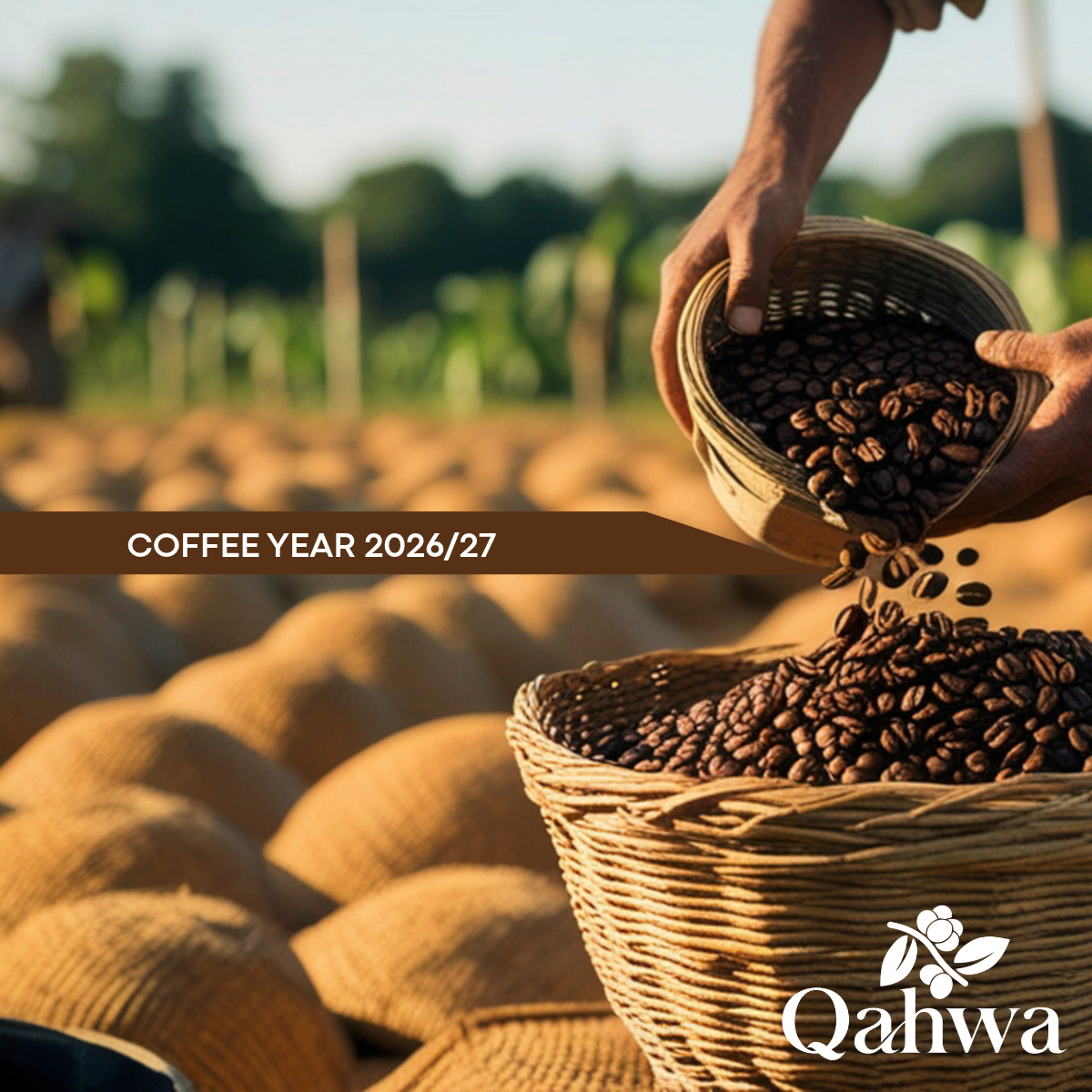
October 1 marks the beginning of a new coffee year. It is a conventional date, but also a useful moment to take stock of the market and shift the focus from forecasts to how those expectations are actually starting to materialise.
Over the past few months, the outlook for 2026/27 has become progressively clearer: estimates point to greater global coffee availability, driven above all by the recovery in Brazilian production.
At the same time, however, physical availability, stocks, differentials and logistics continue to require close attention.
It is precisely this gap between expected production and coffee that is actually available on the market that makes the new coffee year particularly relevant for buyers, importers and roasters.
Higher production does not automatically mean higher availability
Production prospects for 2026/27 are positive. As we already analysed in our latest market update, USDA estimates indicate global production of approximately 189.7 million bags, up from the previous season.
Global consumption is forecast at around 179.7 million bags, while ending stocks could increase for the second consecutive year. Brazil is one of the main drivers behind this rebalancing, thanks to particularly strong production expectations and a significant recovery in Arabica output.
These figures matter, but for green coffee buyers they are only one part of the picture. Between production and commercial availability there are several variables: harvest timing, processing, producers’ selling decisions, inland transport, container availability, shipping, port congestion and arrival times in destination markets. A large crop can therefore improve the global balance sheet without immediately translating into greater physical availability for a European buyer.
The physical market remains central
Recent months have shown how misleading it can be to read the coffee market exclusively through futures. Futures prices and the physical market are closely connected, but they are not the same thing. For a roaster, the key question is not simply how Arabica or Robusta are trading today.
The practical question is:
which coffee is available, with which characteristics, in which location and with what delivery time?
Certified stocks therefore remain an important indicator. During the summer, Arabica certified inventories in particular continued to remain relatively tight, while the Robusta market showed a more complex picture. The new coffee year will need to show how quickly the expected increase in production can translate into stock rebuilding and greater fluidity of supply.
Different origins, different dynamics
In 2026/27, it will still be difficult to speak about “the coffee market” as if it were a single uniform system.
Brazil, Vietnam, Colombia, Ethiopia, Uganda and other major origins are entering the new season with different harvest calendars, availability levels and commercial dynamics.
Origin diversification, a topic we addressed over the past few months, will therefore continue to represent an important tool for reducing dependence on a single producing area.
It does not simply mean buying from more countries. It means understanding how harvest periods, available qualities and export windows can complement each other within a broader procurement strategy.
What buyers should monitor in the coming months
As we enter coffee year 2026/27, there are several factors that buyers and roasters should watch particularly closely:
- the speed at which the Brazilian crop enters commercial flows;
- production and export trends in Vietnam;
- the rebuilding of certified stocks;
- differential movements;
- the balance between Arabica and Robusta in international trade flows;
- EUR/USD exchange rate movements;
- international freight costs and transit times;
- weather developments in major producing regions.
These are different variables, but they are increasingly interconnected.
A favourable movement in futures can be offset by a higher differential.
Higher production may take months to reach European warehouses.
Attractive availability at origin can lose part of its advantage if freight costs or transit times increase.
From forecasting to planning
The beginning of a new coffee year does not create an immediate change in market conditions.
It marks the start of a phase in which many of the expectations built over the previous months will need to be tested against the physical market.
For green coffee buyers, this means continuing to monitor price, but always within a broader picture that includes availability, quality, origin, differentials and timing.
At Qahwa, we continuously monitor the market, EUR/USD movements, availability across origins and logistics conditions in order to plan purchasing and manage stock across our European hubs.
Because in coffee year 2026/27, once again, it will not only matter how much coffee is produced.
What will matter is how much coffee is actually available, where it is located and when it can be delivered.